Seek The Old Paths

Vol. 37   No. 10                   October,   2026

PDF

This Issue...


THE FIRE HE COULD NOT PUT OUT

Derrick Stiles

        Jeremiah knew what it was like to become discouraged while doing the work of God. He had been called to preach to a stubborn and rebellious nation. His message was often rejected, his motives were questioned, and his faithfulness brought him suffering rather than popularity. Yet Jeremiah’s life teaches us something powerful: there may be moments when we feel like quitting, but when God’s Word truly lives within us, there is a fire that refuses to go out.

        Jeremiah’s ministry was not easy. God had warned him from the beginning that people would fight against him (Jer. 1:19). He preached repentance, warned Judah of coming judgment, and pleaded with the people to return to God. Instead of listening, many mocked and opposed him. In Jeremiah 20, that opposition became personal. Pashhur, a priest and chief officer in the house of the Lord, struck Jeremiah and placed him in the stocks (Jer. 20:1-2). Imagine Jeremiah’s condition. He had been publicly humiliated and physically mistreated —not because he had done wrong, but because he had faithfully proclaimed God’s message.
        Sometimes doing what is right does not immediately make life easier. Noah obeyed God but was surrounded by an unbelieving world. Elijah stood for God and found himself running from Jezebel. Paul preached Christ and experienced beatings, imprisonment, rejection, and persecution. Faithfulness does not guarantee freedom from difficulty. Sometimes faithfulness is demonstrated by continuing through the difficulty.
        Jeremiah reached an emotional breaking point. He cried, “I am in derision daily; everyone mocks me” (Jer. 20:7). Every time he spoke, his message brought him more trouble. He confessed, “The word of the LORD was made to me a reproach and a derision daily” (v.8). Finally, Jeremiah decided he had endured enough. He said, “I will not make mention of Him, nor speak anymore in His name” (v.9). In modern language, Jeremiah was saying, “I’m finished. I’m not doing this anymore.” Have you ever felt that way? Perhaps you have tried to encourage someone who refuses to listen. You have attempted to teach the Gospel and been rejected. You have served in the church without feeling appreciated. You have tried to help someone only to have your motives questioned. You have prayed for someone who continues down the wrong path. Eventually, discouragement whispers, “Why keep trying?”
        Jeremiah discovered the answer. He tried to stop speaking, but something happened inside him: “But His word was in my heart like a burning fire shut up in my bones; I was weary of holding it back, and I could not” (Jer. 20:9). Jeremiah could stop his mouth temporarily, but he could not extinguish the message in his heart. That is the difference between simply knowing the Word and allowing the Word to live within us.
        Fire spreads. Fire produces light. Fire produces warmth. Fire changes whatever it touches. Jeremiah had been so deeply affected by God’s Word that remaining silent became harder than speaking. The pressure from the “outside” told him to quit, but the conviction on the “inside” told him to continue. Christians need that same fire today.
        We live in a world that desperately needs the Gospel. There are neighbors who need to hear about Jesus. There are children and grandchildren who need godly examples. There are discouraged Christians who need encouragement. There are wandering souls who need someone to lovingly call them home. There are lost people who need to hear that salvation is available through Christ. Paul expressed a similar conviction when he wrote, “Woe is me if I do not preach the gospel” (1 Cor. 9:16)! Peter and John demonstrated it when authorities commanded them to stop speaking about Jesus. Their answer was, “For we cannot but speak the things which we have seen and heard” (Acts 4:20).
        When the Gospel truly changes us, we cannot be content to keep it to ourselves. However, spiritual fire must be fed. A campfire neglected will eventually become ashes. In the same way, if we neglect prayer, worship, Bible study, Christian fellowship, and service, our enthusiasm will weaken. Paul therefore told Timothy, “Stir up the gift of God which is in you” (2 Tim. 1:6).
        Perhaps the fire in your heart does not burn as brightly as it once did. Maybe disappointment has dampened your enthusiasm. Perhaps criticism has made you hesitant. Maybe unanswered prayers have discouraged you. Jeremiah reminds us that discouragement does not have to be the end of our story. Go back to the Word. Remember the cross. Remember the empty tomb. Remember the forgiveness you once received. Remember the hope of heaven. Remember the souls around you who need Christ. Remember that our labor “is not in vain in the Lord” (1 Cor. 15:58).
        Jeremiah wanted to quit, but he could not put out the fire that burned within him. May God’s Word become so deeply rooted in our hearts that we can say the same. When we are tired, keep serving. When we are criticized, keep loving. When someone rejects the truth, keep teaching. When the work becomes difficult, keep going. The world may try to silence the message, discouragement may try to weaken the messenger, and hardship may tempt us to quit; but when God’s Word is truly burning within us, there is a fire we simply cannot put out.
                1165 Old Smithville Rd.
                McMinnville, TN 37110


Table of Contents


Editorial Column
ONCE SAVED, ALWAYS SAVED #3

Garland M. Robinson

        I refer you to the September issue where we were looking at Scriptures that use the word IF in regards to one forfeiting their salvation.
        Second Peter 1:5-11, “And beside this, giving all diligence, add to your faith virtue; and to virtue knowledge; 6And to knowledge temperance; and to temperance patience; and to patience godliness; 7And to godliness brotherly kindness; and to brotherly kindness charity. 8For IF these things be in you, and abound, they make you that ye shall neither be barren nor unfruitful in the knowledge of our Lord Jesus Christ. 9But he that lacketh these things is blind, and cannot see afar off, and hath forgotten that he was purged from his old sins. 10Wherefore the rather, brethren, give diligence to make your calling and election sure: for IF ye do these things, ye shall never fall: 11For so an entrance shall be ministered unto you abundantly into the everlasting kingdom of our Lord and Saviour Jesus Christ.”
        These verses tell us to apply Christian attributes to our spiritual growth as a Christian. It is said that IF we do so, we will not be “barren or unfruitful” and IF we do these things we “shall never fall.” Verses eight and ten make it clear, by using the word IF, that “being saved” depends upon us adding these things to our life. We will not fall, IF we incorporate them into our life. But, what if we don’t add them? The conclusion is, we will fall. Fall from what? Fall in what regard? Such persons will fall from steadfastness in the Lord (2 Peter 3:17) —fall from grace (Gal. 5:4). There is no other conclusion than to fall from being saved! Man says we can’t fall, God says we can fall.
        Hebrews 3:14, “For we are made partakers of Christ, IF we hold the beginning of our confidence stedfast unto the end.”
        To be a partaker of Christ is another way of saying that we stand in His favor. If we wish to be saved, then we will stand with Him. We will be a part of Him by keeping His Way, His Word. But how is such a relationship with the Lord kept and maintained? It is only IF we hold stedfast to the end of our lives. But, what if we don’t hold fast? The obvious point is that we will not be partakers with Him in His eternal glory in heaven above.
        Hebrews 10:38, “Now the just shall live by faith: but IF any man draw back, my soul shall have no pleasure in him.”
        Christians live by faith. We have confidence in Him. We continue obeying His Word. His word will be used to judge us (cf. John 12:48). This passage implies that IF one continues to live for the Master, he will be saved. However, it is plainly stated that IF one stops living for Him, going back into the world of sin, there is no salvation. The Lord has no pleasure in such a person. Will Jesus save those in whom He has no pleasure? No not one!
        Romans 8:13, “For IF ye live after the flesh, ye shall die: but IF ye through the Spirit do mortify the deeds of the body, ye shall live.”
        We have the approval of God when we repent and put to death (separate from, not yield to) our lusts and passions. We must stop living for ourselves; and instead, live for Him. Salvation is made conditional by the word IF in this verse. IF we mortify (put to death) the deeds of the body, we shall live. But the question is, what IF we don’t put to death the deeds of the body after becoming a Christian? The obvious and clear point is, we will not live with Him in eternity. If that’s not losing your salvation, then what in the world could it be?
        Romans 11:22, “Behold therefore the goodness and severity of God: on them which fell, severity; but toward thee, goodness, IF thou continue in his goodness: otherwise thou also shalt be cut off.”
        This verse shows the consequences of not living as we’ve been instructed. We are to live in His goodness; that is, His Law, His Word. But, receiving God’s goodness is conditioned upon our living in His goodness. Otherwise, we will be “cut off.” If a Christian can’t be lost eternally, then I guess “cut off” doesn’t mean “cut off.” If that is so, that makes God a liar. Practically every page of the Bible is going to have to be re-written if a Christian can’t ever so sin as to be lost.

WHAT DO WE DO WITH THOSE WHO FELL AWAY?

        If a Christian can’t be lost, what do we do with the passages that tell us of those who fell away and were lost? Not only do we have multiplied warnings against falling away, but we also have example after example of some who did fall away.
        Acts 1:25, “That he may take part of this ministry and apostleship, from which Judas by transgression fell, that he might go to his own place.”
        Judas Iscariot was chosen by the Lord to be one of the twelve apostles. He lived and listened to Jesus for over three years. This verse says Judas FELL. Do we expect to see him in heaven some day? No we don’t.
        Acts 5:1-10 tells us of a Christian couple that who fell. “But a certain man named Ananias, with Sapphira his wife, sold a possession, 2And kept back part of the price, his wife also being privy to it, and brought a certain part, and laid it at the apostles’ feet. 3But Peter said, Ananias, why hath Satan filled thine heart to lie to the Holy Ghost, and to keep back part of the price of the land? 4Whiles it remained, was it not thine own? and after it was sold, was it not in thine own power? why hast thou conceived this thing in thine heart? thou hast not lied unto men, but unto God. 5And Ananias hearing these words fell down, and gave up the ghost: and great fear came on all them that heard these things. 6And the young men arose, wound him up, and carried him out, and buried him. 7And it was about the space of three hours after, when his wife, not knowing what was done, came in. 8And Peter answered unto her, Tell me whether ye sold the land for so much? And she said, Yea, for so much. 9Then Peter said unto her, How is it that ye have agreed together to tempt the Spirit of the Lord? behold, the feet of them which have buried thy husband are at the door, and shall carry thee out. 10Then fell she down straightway at his feet, and yielded up the ghost: and the young men came in, and found her dead, and, carrying her forth, buried her by her husband.”
        This Christian couple conspired with each other to lie about their giving. They were punished with immediate death. They fell away from the Lord. The punishment brought upon them caused great fear to come upon the whole church. It is a grievous error to lie to God. Lying brings eternal destruction to one’s soul. All liars “...shall have their part in the lake which burneth with fire and brimstone: which is the second death” (Rev. 21:8).
        Acts 8:18-24 tells us of a man who had made his living by deceiving people through the practice of sorcery. Upon hearing the Gospel preached by Philip, He was among others who believed it and were baptized for the remission of their sins (cf. Acts 8:12-13; 2:38; 22:16). These verses tell us what he saw and what he did after becoming a Christian.
        “And when Simon saw that through laying on of the apostles’ hands the Holy Ghost was given, he offered them [Peter and John] money, 19Saying, Give me also this power, that on whomsoever I lay hands, he may receive the Holy Ghost. 20But Peter said unto him, Thy money perish with thee, because thou hast thought that the gift of God may be purchased with money. 21Thou hast neither part nor lot in this matter: for thy heart is not right in the sight of God. 22Repent therefore of this thy wickedness, and pray God, if perhaps the thought of thine heart may be forgiven thee. 23For I perceive that thou art in the gall of bitterness, and in the bond of iniquity. 24Then answered Simon, and said, Pray ye to the Lord for me, that none of these things which ye have spoken come upon me.”
        Simon fell back into the lusts of his old trade when he saw miraculous gifts being given through the laying on of the apostle’s hands. Peter told him his heart was not right in the sight of God and that he needed to repent of his wickedness. Fortunately, he did so and was forgiven. But, what if he had not repented? The point is, his heart would have continued not being right in the sight of God and he would have been lost.
        Second Timothy 4:10, “For Demas hath forsaken me, having loved this present world...”
        Demas was once a faithful soldier of the cross. So much so that he became a traveling companion of Paul. Not just anyone would leave their home and make such an extended journey not knowing what dangers would be forthcoming. At some point along the way, he abandoned Paul because he loved this present evil world. The doctrine of “once saved always saved” would have us believe he would still be saved eternally even though he left the Lord and returned to worldly living.
        First Timothy 1:19-20, “Holding faith, and a good conscience; which some having put away concerning faith have made shipwreck: 20Of whom is Hymenaeus and Alexander; whom I have delivered unto Satan, that they may learn not to blaspheme.”
        Hymenaeus and Alexander were Christians who had become unfaithful. They had “put away” the faith. They couldn’t put it away if they never had it. Their departure from faithfulness to the Lord is described as a “shipwreck.” They were lost. How could it possibly be understood otherwise?
        First Timothy 6:10, “For the love of money is the root of all evil: which while some coveted after, they have erred from the faith, and pierced themselves through with many sorrows.”
        Notice the word “from.” They had erred “from” the faith. If one can’t be lost, then he can’t err from it. Yet some had actually done so. Verse 21 says the same thing. “Which some professing have erred concerning the faith....”
        Second Timothy 2:18, “Who concerning the truth have erred, saying that the resurrection is past already; and overthrow the faith of some.”
        Should we suppose that to err from the truth and have your faith overthrown doesn’t actually mean you will be lost? Even a child can understand this verse. Therefore, James 1:16 warns, “Do not err, my beloved brethren.”

CONCLUSION

        The typical response the “once saved always saved” crowd gives to the Scriptural argument that a Christian can sin and lose their salvation is this: “if one falls away, then they were never saved to begin with because if they were truly saved they would not fall away.” This is “circular reasoning” —like a dog trying to catch his tail.
        In desperation, they don’t know what else to say. They can’t point to a verse that teaches what they teach, so they have no answer at all. They fail in their attempt to explain away the dozens and dozens of verses that clearly exhort Christians to remain faithful and not give up or else they will be lost. As a matter of fact, those who turn back to the world after becoming a Christian are worse off than had they never become a Christian.
        Notice what the Holy Spirit says about man’s doctrine of “once saved always saved.” “For if after they have escaped the pollutions of the world through the knowledge of the Lord and Saviour Jesus Christ, they are again entangled therein, and overcome, the latter end is worse with them than the beginning. 21For it had been better for them not to have known the way of righteousness, than, after they have known [it], to turn from the holy commandment delivered unto them. 22But it is happened unto them according to the true proverb, The dog [is] turned to his own vomit again; and the sow that was washed to her wallowing in the mire” (2 Peter 2:20-22).
        If a Christian can’t fall away and be lost, then...        

  • We don’t have to pray for the Lord to “lead us not into temptation” (Matt. 6:13).
  •        
  • We don’t have to “watch and pray” (Matt. 26:41).
  •        
  • We don’t have to “put on the whole armour of God, that ye may be able to stand against the wiles of the devil” (Eph. 6:11).
  •        
  • We don’t have to worry about “Satan taking advantage of us” nor do we have to worry about “being ignorant of his devices” (2 Cor. 2:11).
  •        
  • We don’t have to worry about being “beguiled by Satan” through his subtilty and “our minds being corrupted” from the simplicity that is in Christ (2 Cor. 11:3).
  •        
  • We don’t have to worry about Satan “transforming himself into an angel of light” (2 Cor. 11:14) in order that he might destroy us.
  •        
  • We don’t have to worry about not “giving place to the devil” (Eph. 4:27).
  •        
  • We don’t have to worry about being “tempted of the tempter and our labor being in vain” (1 Thess. 3:5).
  •        
  • We don’t have to worry about being trapped in the “snare of the devil” or being taken “captive by him” at his will (2 Tim. 2:26).
  •        
  • We don’t have to be concerned about “the great dragon that old serpent, called the Devil, and Satan, which deceiveth the whole world” (Rev. 12:9).
        FRIEND, you had better be concerned about your soul. Heed the warnings of God in His Word. Don’t follow the examples of those who fell away. Don’t listen to the devil when he says you can’t fall away. Instead, believe Jesus who says, “he that endureth to the end shall be saved” (Matt. 10:22). But, what if you don’t endure to the end? Then you won’t be saved!


Table of Contents


THE FLOOD AND THE LONGEVITY OF MAN’S LIFE

Jon Gary Williams

        For many years those who reject the Bible have sought to find things within its pages showing it to be only a myth. A reference often cited is the fifth chapter of the book of Genesis which attributes extremely long ages to men, into many hundreds of years. It is presumed that men could not possibly have lived to such ages and, therefore, the Bible must be erroneous. However, when looking carefully at the Genesis record information is discovered explaining why this account is not only logical, but scientific.
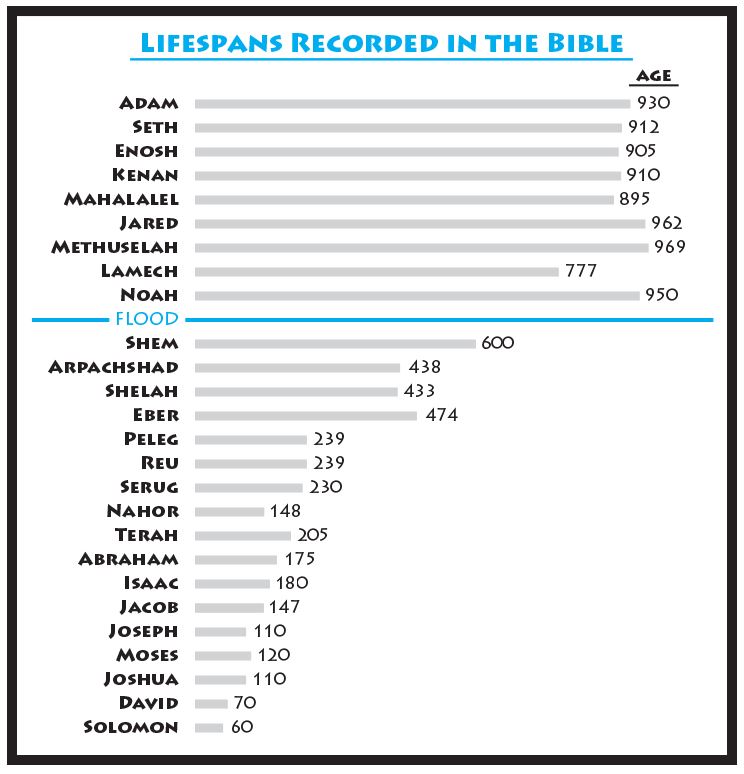
        The Biblical record is clear in stating that men lived to extreme ages during the earlier period of man’s history. From the time of Adam to the time of Noah the average age of man was more than 900 years, Methuselah living the longest, to 969 years. In contrast however, after Noah, the ages of men began to sharply decline. For example, Noah’s son, Shem, lived 600 years, and his son, Arpachshad, lived 438 years. Over time man’s life span continued to decrease, eventually averaging far below 100.
        Taking into consideration this drastic change in man’s life span and the time when it began to take place, it is immediately apparent that the flood had something to do with this change in man’s longevity. What, regarding the flood, could there have been which caused such a reduction in the years men were capable of living? Was there something different about the earth after the flood?
        To find the answer to these questions, it is necessary to look back to the physical conditions existing on the early earth. From Genesis 1:5-6 we learn that at the beginning there was no rain, but, rather, that the earth was watered by a “mist.” Rain is not mentioned until the time of the flood (Gen. 7:4). Between the creation week and the flood a misty canopy must have enveloped the earth. Such a moister belt would have prevented much of the sun’s radiation from penetrating the atmosphere. It is well known that isotope radiation negatively affects man’s life span; statistical studies have shown that overdoses of radiation lead to premature aging. On the other hand, protection from radiation provided by such a moister belt would have prolonged man’s life span.
        Additionally, the “mist” surrounding the earth being condensed into rain, was the source of much of the flood water. Yet, most of the water probably came from the “fountains of the great deep,” or the earth’s subterranean waters (Gen. 7:11).
        The following graph illustrates the drastic difference in the longevity of man’s life before and after the Genesis flood.
                jongaryw@aol.com
                www.jongarywilliams.com


chart


Table of Contents


SPIRITUAL IGNORANCE IS FATAL

Marvin L. Weir

        The fourth chapter of Hosea highlights a sinful people and God’s exposure of their evil character. Jehovah had “a controversy” with His people because there was “no truth, nor goodness, nor knowledge of God in the land” (Hosea 6:1). A lack of knowledge will ruin any person or nation —“You just can’t warn some people.” May it never be said of us that spiritual ignorance is destroying our souls!
        Ignorance Of God Is Far Too Common! God’s wisdom and mighty power was demonstrated to Israel again and again. There was an abundance of messages from the lips and lives of faithful prophets to stir the minds of God’s people, and yet in their lives they knew Him not. What a tragedy it is when God tries so hard and His people hardly try at all!
        Nothing has changed in the lips and lives of many people who profess to be Christians today. So many are content to follow the path of least resistance. Not a few try to justify their ignorance of the Holy Scriptures by alleging that one cannot really know God. This is a denial of Jesus Himself who said that He is “...the image of the invisible God, the firstborn of every creature” (Col. 1:15). Christ taught His followers that if they had seen Him they had seen the Father. John’s Gospel account records, “Thomas saith unto him, Lord, we know not whither thou goest; and how can we know the way? Jesus saith unto him, I am the way, the truth, and the life: no man cometh unto the Father, but by me. If ye had known me, ye should have known my Father also: and from henceforth ye know him, and have seen him. Philip saith unto him, Lord, shew us the Father, and it sufficeth us. Jesus saith unto him, Have I been so long time with you, and yet hast thou not known me, Philip? he that hath seen me hath seen the Father; and how sayest thou [then], Shew us the Father” (John 14:5-9)? God revealed Himself to mankind through His Son, and we have the Son’s spoken Word stating that such is true. How then can men rightly say that God cannot be known?
        Ignorance Of God Is Often Willful! God clearly stated that His people had “rejected knowledge” (Hosea 4:6). In order for these people to reject knowledge, knowledge had to be available. So it is today! The apostle Paul, in speaking of the Jews, said, “For they being ignorant of God’s righteousness, and going about to establish their own righteousness, have not submitted themselves unto the righteousness of God” (Rom. 10:3). The righteousness of God was available to be known but these people were willfully blind because they loved darkness rather than light. Darkness is always much preferred when one is desiring to involve himself in selfish and evil deeds. One must desire to know God and not neglect God if he is to save his soul!
        Willful Ignorance Of God Is Fatal! “My people are destroyed for lack of knowledge” (Hosea 4:6). A branch, severed from the vine, will die. God will not be mocked, and willful ignorance will lead to His wrath. The path of willful ignorance unless repented of will always lead to Divine Rejection: “...because thou hast rejected knowledge, I will also reject thee” (Hosea 4:6). One must have fellowship with God to save his soul but there can be no fellowship with God if one despises or ignores the light of His Word. The darkness of the unbelieving mind cuts off the helping hands of God. Burton Coffman comments on this verse of Scripture as follows:

Educators and public leaders like to quote this verse, but all too frequently they are unaware of what is meant by knowledge in this passage. It is not scientific, secular, or technical knowledge that is meant, but religious knowledge, the knowledge of God through his revealed will, the Bible; and even more than this is meant; it means conformity to the will of God. H. G. Wells said that, “Civilization is a race between education and catastrophe,” but only a fool today believes that secular education alone can stave off catastrophe ... Catastrophe overtakes a civilization not because it lacks intelligence, but because it lacks integrity.” Why does integrity, or morality, depend upon the knowledge and worship of God in the fullest sense of those words? Simply because the naive notion that if men know right they will do it is a fool’s nightmare. Only the true religion of God can endow moral and ethical behavior with cosmic significance. “There are no significant examples, before our time, of a society successfully maintaining moral life without the aid of religion.” Will Durant held to the opinion that our own liberal society in the United States would be able to achieve what no other ever did, that is, maintain morality and integrity without regard to true religion; hence his inclusion of the phrase “before our time” in the passage quoted. The events of the first decade following his statement, however, have already demonstrated the fantastic dimensions of his error. Without a widespread reawakening of the national conscience and a wholesale return to the teachings of the Word of God, our own beloved America is already launched upon a collision course with disaster.

        Glory Turned Into Shame. “As they were multiplied, so they sinned against me: I will change their glory into shame” (Hosea 4:7). What were God’s people glorying in? Was it false gods, growing numbers, material prosperity, or their satisfied freedom from Divine restraint? Perhaps it was all of the above, but it is certain they were not glorying in Jehovah. Thus, He will turn His people’s glory into shame. Jehovah is a “jealous God” that will visit the sins of the fathers upon generations to come (Deut. 5:9). Under the New Covenant it is stated, “For I am jealous over you with godly jealousy: for I have espoused you to one husband, that I may present [you as] a chaste virgin to Christ” (2 Cor. 11:2).
        Fruitless Effort. “For they shall eat, and not have enough: they shall commit whoredom, and shall not increase: because they have left off to take heed to the LORD” (Hosea 4:10). Such is the experience of worldly people. Lack of knowledge blinds people to the hunger of their own souls. Christ is the “bread of life” that one may eat of and not die (John 6:48-50). Spiritual ignorance starves the soul and leaves man without hope!
        May we choose to feast upon His Word before it is too late to do so!
                484 CR 44700
                Blossom, TX 75416


Table of Contents


A NEW CREATURE IN CHRIST

Roger D. Campbell

The Bible nowhere says that one is “in Christ” as a result of hearing, believing, repenting, confessing or even asking Jesus to come into your heart to be your personal savior. The only way to get “into Christ” is to be baptized in water for the remission of your sins (Rom. 6:3; Gal. 3:27).

        “Therefore if any man be in Christ, he is a new creature; old things are passed away; behold, all things are become new” (2 Cor. 5:17). This verse shows “where” a Christian is —he is IN Christ. It also shows “what” a Christian is —he is a new creature or new creation. Paul used this expression on another occasion when writing to the churches of Galatia, “For in Christ Jesus neither circumcision availeth any thing, nor uncircumcision, but a new creature” (Gal. 6:15). We are not surprised that one in Christ has a new life, for Jesus Himself told Nicodemus, “Ye must be born again in order to enter the kingdom of God” (John 3:5,7). We want to examine what is written in 2 Corinthians 5:17 and see how this verse describes the life of one who follows Christ.

        IN CHRIST: All new creations, that is, all who have been born again, are in Christ Jesus. If we are in Christ, then we did not get into Him by accident! One enters into Christ, not by physical birth, but by spiritual birth. This takes place only under the conditions that God has set forth in the Bible. One cannot be saved without believing (John 3:16-18), and one cannot have faith without first hearing the word (Rom. 10:17), but the Bible nowhere says that one is already in Christ as a result of hearing and believing. One who is seriously studying God’s word and has already believed in the Deity of Jesus is going in the right direction, the path to salvation, but he is not yet in Christ, and thus not yet saved. Repentance, and confessing Jesus as the Son of God are also conditions of salvation (Acts 17:30; Rom.10:10). But again, the Bible nowhere teaches that one who has repented and confessed Jesus is already in Christ. According to the Bible, just “when” is it that one enters Christ? “For ye are all the children of God by faith in Christ Jesus. For as many of you as have been baptized into Christ have put on Christ” (Gal. 3:26,27). “Know ye not, that so many of us as were baptized into Jesus Christ were baptized into his death” (Rom. 6:3). These two passages plainly show that one enters Christ by being baptized, for in each case it says that those to whom he writes were baptized into Christ. Please do not misunderstand us. We are not saying that baptism is more important than faith, repentance, or confession of Christ. But, according to the teaching of Christ, the final action which puts one into Christ is water baptism for the remission of sins (Acts 2:38).
        What blessings do we have in Christ Jesus? All spiritual blessings are IN Christ (Eph. 1:3). No spiritual blessings are “out of Christ.”

        We have REDEMPTION “in Christ,” as it is written, “Being justified freely by his grace through the redemption that is ‘in Christ’ Jesus” (Rom. 3:23-24). Paul later wrote of the salvation which is “in Christ” Jesus (2 Tim. 2:10). What a blessing it is to be a child of God, for He hath blessed us with all spiritual blessings in heavenly places in Christ (Eph. 1:3). If all spiritual blessings are in Christ, then there are no real spiritual blessings outside of Christ!

        OLD THINGS ARE PASSED AWAY as a result of being “in Christ.” We are a new man or a new creation, and the person that we used to be before entering Christ is called the “old man.” This old man, that is, our old way of life, must be put off: “That ye put off concerning the former conversation the old man, which is corrupt according to the deceitful lusts” (Eph. 4:22). “Knowing this, that our old man is crucified with him, that the body of sin might be destroyed” (Rom. 6:6). Yes, our “old man” died and was buried at the time of baptism (Col. 2:12. So, after baptism we must walk in newness of life (Rom. 6:4). How did our old man live? “Among whom also we all had our conversation [life, behavior] in times past in the lusts of our flesh, fulfilling the desires of the flesh and of the mind; and were by nature the children of wrath, even as others” (Eph. 2:3). Since we are now in Christ, we must forsake the ways of the old man! Whereas before we became Christians we used our bodies as instruments of sin, fulfilling the lusts of the flesh, in Christ we must use our bodies as instruments of righteousness, not allowing sin to reign within us (Rom. 6:12-13).
        What are some specific things of the old man that we must put off? “But now ye also put off all these; anger, wrath, malice, blasphemy, filthy communication out of your mouth. Lie not one to another, seeing that ye have put off the old man with his deeds” (Col. 3:8-9). Did you notice that the text says we must “put off” all these? That is right, if we want to please God, we must repent of all our past sins and remove all wickedness from our lives. Sometimes it appears that people want to bargain with God. They are willing to forsake some of their sins, that is, in part put off the old man, but they want to continue participating in other sins, and they want God to accept this compromise. It will not work! God will not accept such a compromise, for He plainly tells us to put off all the sins and corruption of the old man. If you want to know of other sins of the old man that we must put off, then read Eph. 4:25-31, Gal. 5:19-21, and 1 Cor. 6:9-11.

        A NEW CREATURE: When our clothes get dirty we take them off. But then what do we do? We put on clean clothes to replace them. In the same way, we must not only quit our old sinful habits and thus put off the old man, but we must, in the place of them, put on what God wants us to put on. Paul reminded the saints in Thessalonica that they had turned to God “from idols” to “serve” the living and true God (1 Thess. 1:9). It was great they had stopped serving idols, but forsaking that sin was not enough. In addition to putting off their idols, they had to turn to serve the living God. The Bible says that in Christ all things are become new, so we do not stay the same as we were before our baptism —there must be some changes in our life! The Holy Spirit instructs us, “And be renewed in the spirit of your mind; And that ye put on the new man, which after God is created in righteousness and true holiness” (Eph. 4:23-24). In that same epistle Paul wrote, “For we are his workmanship, created in Christ Jesus unto good works, which God hath before ordained that we should walk in them” (2:10). When we were “baptized into Christ” we “put on Christ” (Gal. 3:27), so we are living as a new creation; and, Christ is now living in us (Gal. 2:20).
        What are some specific qualities we are to put on in Christ? Paul said that as the elect of God we must put on these: “bowels of mercies, kindness, humbleness of mind, meekness, longsuffering, forbearance, a forgiving spirit, and love” (Col. 3:12-14). Our new life in Christ Jesus certainly includes applying the following to our lives: “And beside this, giving all diligence, add to your faith virtue; and to virtue knowledge; And to knowledge temperance; and to temperance patience; and to patience godliness; And to godliness brotherly kindness; and to brotherly kindness charity” (2 Peter 1:5-7). All of us understand that a Christian must not participate in activities that are sinful, but at the same time, as a new person we must put on the godly qualities that our Lord wants us to possess, imitate Jesus, and be active bearing fruit for His glory (John 15:8).

        ALL THINGS ARE BECOME NEW: What do we have in Christ that is new? Consider these ten brief answers (please open your Bible and read all the verses). “In Christ” we have...

        1. A New Life. We have been “born again” by the incorruptible seed, the word of God (1 Peter 1:23). After baptism we are to walk in newness of life (Rom. 6:3,4). Jesus said, “I am come that they might have life, and that they might have it more abundantly” (John 10:10). In Christ Jesus, we have the very best life possible!

        2. A New Name. Because we are followers of Christ, we are called Christians (1 Peter 4:16; Acts 11:26; 26:28).

        3. A New Fellowship. Before our conversion to Christ we were the children of the devil (Acts 13:10), but now as the children of the living God we have fellowship with the Father, Son and Holy Spirit (1 John 1:3; 2 Cor. 13:14). In addition to this, in Christ, we have fellowship with other faithful children of God —our brothers and sisters in the Lord (1 John 1:7).

        4. A New Standard To Follow. Before conversation we may have had heros or special people we imitated, but in Christ we strive to imitate the only one who lived on the earth without sin, Jesus, the Christ (1 Peter 2:22). His standard or example is without blemish. We must have the heart that He did (Phil. 2:5).

        5. A New Motive. The old man lived to please himself and to fulfill the lusts of his flesh. The new man in Christ must deny himself (Luke 9:23) and strive always to please God, loving what the Lord loves and hating what He hates (Heb. 1:9).

        6. A New Purpose In Life. In Christ, we desire to give glory to God in all things (1 Cor. 10:31). We must keep our eyes focused on heaven itself, for our ultimate goal is to spend eternity with the Lord. “...But this one thing I do, forgetting those things which are behind, and reaching forth unto those things which are before. I press toward the mark for the prize of the high calling of God in Christ Jesus” (Phil. 3:13-14).

        7. A New Reward. While living on the earth in Christ, we have the forgiveness of sins, freedom from sin, peace in our hearts, and hope. We will receive eternal life in the life to come (Mark 10:30). That great reward, called the crown of life, is prepared for those who love the Lord (James 1:12).

        8. A New Outlook On Life. In Christ, we learn to trust in the Lord and not worry about material things, for our Lord has taught us to seek first the kingdom of God and His righteousness (Matt. 6:33). For the old man, only the things of the world and the flesh matter, but in the heart of one who is truly a new man, spiritual affairs are most important (Col. 3:2).

        9. A New Home. In the sight of God, it is not important where we were born physically or in which nation we have our citizenship. However, to Him (and us!) it is important where our last home will be. For those who faithfully follow Jesus there is a beautiful, eternal home of the soul, of which God is the builder and maker, that awaits us (Heb. 11:10,16).

        10. New Duties/Responsibilities. Sometimes people love the blessings we have listed in numbers 1-9, but they do not like to think about the responsibilities one has in Christ. The new creature in Jesus must know these responsibilities and, with joy, carry them out for the One who died for their salvation! What is our basic responsibility in Christ? Follow Him. Follow Him today, tomorrow, and every day. Does that include fulfilling His will? Of course! For this is the love of God that we keep his commandments; and his commandments are not grievous (1 John 5:3).
        It is essential to be “in Christ” in order to be saved, but it is not enough just to have been baptized into Christ. In Him we must live faithfully to the end.
        May God help each of us to remember who we are, where we have been, and where we are going.
                125 Covered Bridge Rd.
                Bremen, GA 30110


Table of Contents


HOW OFTEN SHOULD WE EAT THE LORD’S SUPPER?

Garland M. Robinson

        The Lord’s supper is a memorial that commemorates Jesus’ suffering and death on the cross. Two elements are used in this memorial: “unleaven bread” and “fruit of the vine.” These were eaten during the Passover (Exodus 12:15). It was during the Passover the night before Jesus was crucified that He instituted the Lord’s supper (Matt. 26:26-29) to be observed in His kingdom/church (Matt. 16:18-19; Luke 22:16,18).
        The church of the first century ate the Lord’s supper on a regular basis, “...they continued stedfastly in the apostles’ doctrine and fellowship, and in breaking of bread, and in prayers.” “Breaking of bread” is a figure of speech indicating the Lord’s supper. Since this verse gives no indication as to the frequency it was eaten, are we at liberty to observe it whenever we desire? The answer is NO.
        Churches of the first century met on the first day of the week. This was the day on which the Lord was raised from the dead (Mark 16:2-6) and the church was established (Acts 2). It was also the day on which the church observed the Lord’s supper. “Upon the first day of the week, when the disciples came together to break bread...” (Acts 20:7).
        But, someone says, this does not say they observed it every first day of every week or only on the first day of the week. How many weeks have a first day? All of them! When God commanded the Israelites to “Remember the sabbath day” (Exodus 20:8), how often were they to remember it? Was it whenever they chose? Could they observe it on the sixth or second day? No! It was every Sabbath (7th day) even though it was not expressly stated. The same is true with the Lord’s supper.
        Every first day of every week the Lord’s church is to meet together to eat the Lord’s supper as they did in the first century. What was done in one congregation was done in all congregations (Acts 16:4). When we meet on the first day of the week, we are following the example of the apostles.


Table of Contents


Home | Bible Page |
Seek The Old Paths | Leoni Church of Christ | WSOJ Radio
Lectureship Books