Seek The Old Paths

Vol. 37   No. 9                                                      September,   2026

PDF

This Issue...


PREMILLENNIALISM EXAMINED

Jon Gary Williams

        The word Premillennialism comes from “pre” (before) and “millennial” (1,000). Some contend that when Christ returns, a 1000-year utopia period will begin, during which He will reign on a literal throne at Jerusalem; hence, Christ’s coming, as well as other particular events, will occur “before the millennium.”

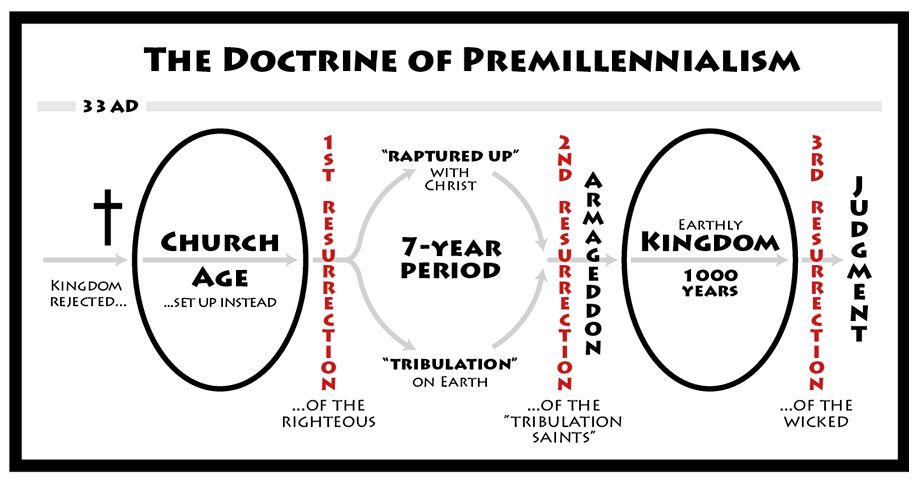
AN OVERVIEW OF THE DOCTRINE OF PREMILLENNIALISM

        Premillennialism has been known to take various forms, with slight discrepancies within the different tenets of the doctrine. But in general terms, the teaching holds to the following premises:

  • When Christ came to set up His kingdom, He was rejected by the Jews. Christ then postponed the establishment of the kingdom and established a “church age” instead.
  • At the end of this “church age” there will be a first of three resurrections — that being a resurrection of the “righteous dead.”
  • This will be followed by the church being “raptured” up for seven years to be with the coming Christ. During this seven-year span there will be a period of great “tribulation” on earth.
  • At the end of the seven-year tribulation period, Christ will complete His return. At that time there will be a second resurrection — this time for the resurrecting of the “tribulation saints.”
  • There will then occur a great physical war called “Armageddon,” between the forces of Christ and the forces of Satan.
  • Christ will be victorious in this war, and the postponed kingdom will then be set up.
  • For 1,000 years Christ will reign on a physical throne from the city of Jerusalem. At the end of this 1,000-year period there will be a third resurrection, this one reserved specifically for the wicked dead.
  • Lastly will come the judgment and the destruction of the heavens and earth.


VARIOUS IDEAS OF PREMILLENNIALISM:
DISPROVED IN LIGHT OF SCRIPTURE

        Below are a few general statements made by those who advocate this doctrine, with scriptures provided which refute these various religious ideas.

        “The kingdom, as foretold by Old Testament prophets, was postponed and was replaced by a ‘church age’.”
        What does the Bible tell us?
        1. The kingdom has already been in existence, since the first century. (Col. 1:13; Rev. 1:9)
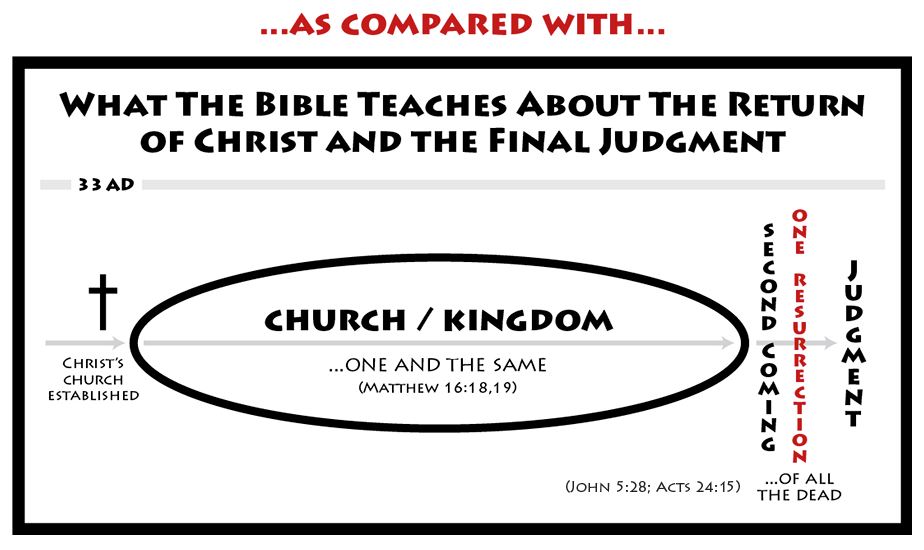
        2. The kingdom and the church were not different. Rather, they were, and still are, one and the same. (Matt. 16:18-19; Col. 1:13,18).

        “There will occur a seven-year ‘tribulation’ period.”
        1. Jesus spoke of a “tribulation” (Matt. 24:29), however, it was to take place “before” the passing of the generation of people to whom Jesus was speaking (Matt. 24:34). Also, this “tribulation” involved a “desolation” in which armies would compass Jerusalem (Matt. 24:1-2; Luke 21:20). (This obviously refers to the Roman armies surrounding and destroying Jerusalem in 70 A.D.)
        2. In the first century a “tribulation” was already being experienced (Rev. 1:9).

        “There will be a seven-year ‘rapture’ period.”
        This idea is not found in the scriptures. At the second coming of Jesus, those who ascend to meet Him will not be with Him for a seven year period; they will be with Him forever (1 Thess. 4:17).

        “There will be three separate resurrections, for three different groups of people.”
        1. All who are in the graves will be raised together (John 5:28-29).
        2. There will be only one resurrection, including both the “just” and the “unjust” (Acts 24:15).

        “A great ‘Armageddon’ battle will occur here on Earth, between Christ and Satan.”
        1. The word “Armageddon” appears only once in the Bible — in the highly symbolic book of Revelation (Rev. 16:16). It has nothing to do with an event in the distant future. It is futile to attempt to justify a doctrine solely on the basis of the symbolic language of Revelation.
        2. Remember, the time frame for the events mentioned in Revelation were limited to what would “shortly come to pass” and “shortly be done” (Rev. 1:1; 22:6).

        “Christ will reign on earth, on a literal throne.”
        1. The scriptures teach that Christ would rule as a priest on a throne (Zech. 6:13).
        2. The scriptures also teach that Christ would not be a priest on earth (Heb. 8:4).
        3. Since Christ would rule as priest on a throne, yet could not be a priest on earth, He could not rule on an earthly throne.
        4. When Jesus returns He will come no closer to this earth than the clouds (1 Thess. 4:17).

        “Christ is not yet ruling as king - - this is yet to occur.”
        1. Christ was to begin His reign as King after His resurrection (Acts 2:29-31).
        2. When Revelation was written, Christ was already “King” (Rev. 17:14; 19:16).

        “Christ’s earthly reign will occur during a 1,000-year (millennial) period.”
        1. Those who teach this view lift it from Revelation 20:1-3, claiming that the “thousand years” must be literal. If this is true, then other parts of this highly symbolic text (such as: “key,” “bottomless pit,” “chain,” “laid hold on“) must also be understood literally. However, those defending this view know these other parts cannot be understood literally. In this, the inconsistency is evident.
        2. Nothing at all is revealed in Revelation chapter 20 about: a) the second coming of Christ, b) the establishment of a kingdom, c) an earthly reign of Christ, d) or any of the teachings of premillennialism.
        3. Again, beware of any doctrine that seeks justification by appealing to the highly symbolic language of the book of Revelation.

        Some Premillennialists also believe that the earth will be changed into a new literal heaven and earth and will last forever.
        1. Jesus taught that heaven and earth would “pass away” (Matt. 5:18; 24:35).
        2. The apostle Peter said that heaven would “pass away” and the earth would be “burned up” (2 Peter 3:10).
                        jongaryw@aol.com


Table of Contents


Editorial Column
ONCE SAVED, ALWAYS SAVED #2


Garland M. Robinson


        Many passages speak of the danger and falling away from God and being eternally lost.
        1 Timothy 3:6: “...lest being lifted up with pride he fall into the condemnation of the devil.” The emphasis in this verse is to show that one can “fall.” The Bible is clear as to the consequences of the sin of pride. “The wicked, through the pride of his countenance, will not seek after God: God is not in all his thoughts” (Psalm 10:4). “The fear of the LORD is to hate evil: pride, and arrogancy, and the evil way, and the froward mouth, do I hate” (Prov. 8:13). “Pride goeth before destruction, and an haughty spirit before a fall” (Prov. 16:18). “For all that is in the world, the lust of the flesh, and the lust of the eyes, and the pride of life, is not of the Father, but is of the world” (1 John 2:16).
        Pride has been, and is, the downfall of everyone who embraces it. It caused the devil to be condemned by God and the warning of First Timothy 3:6 shows that anyone can “fall” into the same condemnation. Who will believe that God condemned the devil for his pride, but will not condemn men who do the same thing as the devil?
        2 Peter 3:17: “...Seeing ye know these things before, beware lest ye also, being led away with the error of the wicked, fall from your own stedfastness.” This passage says a Christian can be led away from God. A Christian can “fall” by not remaining faithful, firm, solid. If this is not so, then someone needs to inform God that He is mistaken and that Christians can’t fall.
        Verse 16 goes on to tell about those who “wrest” (pervert, twist, wrench, torture, misuse) the Scriptures “unto their own destruction.” Does the word “destruction” not mean what we know it means? Its definition is: “ruin or loss (physical, spiritual or eternal), damnable, perdition, perish, waste.” So, let me get this straight. This verse says that those who pervert the Scriptures have fallen from faithfulness and will be lost as a result. They will perish spiritually, eternally. If you run across someone who tells you that God does not mean what He says, then run away from them immediately and hold to the Bible, not false doctrine.
        Verse 17 tells us to “beware” (be on guard). Beware of what? Be on guard about what? We are to beware of those who would lead us away from the Truth and into error. When we follow error, we fall from our stedfastness in the Truth. And, if we don’t follow the Truth, we cannot be saved because Jesus said the Truth is what makes us free from our sins (John 8:31-32). It’s only when we obey the Truth that our souls are purified and cleansed from sin (1 Peter 1:22). Obey God and you will be saved. Obey the devil and you will not be saved. It’s that simple to understand!
        1 Corinthians 9:27: “But I keep under my body, and bring it into subjection: lest that by any means, when I have preached to others, I myself should be a castaway.” The word “castaway” means: “un approved, rejected, worthless, reprobate.” This verse clearly says that Christians are to continually take heed to themselves. We are to make sure we do the Lord’s will and not depart from it. We must continually yield our will to the will of the Lord (cf. Rom. 6:12-18). And, if we don’t, we can’t expect to go to heaven when we die.
        If one can’t fall away and be lost, then a very pertinent question needs to be asked. Paul, if one can’t so sin as to be eternally lost, then why bother with watching out for our soul? Why would you be concerned regarding your own soul? Did the Holy Spirit not lead you to believe in the doctrine of Calvinism that says you can’t be lost? This is a strange passage indeed if it is the case that one cannot fall away and lose their soul.
        Hebrews 12:15, “Looking diligently lest any man fail of the grace of God; lest any root of bitterness springing up trouble you, and thereby many be defiled.” Why must we take such pains to do the Lord’s will? Because if we don’t, we will fail in the grace of God. Since God’s grace saves us (Eph. 2:8), then we want to make sure we don’t fail in regards to it. If we fail when it comes to grace, we are of all men most miserable (cf. 1 Cor. 15:19). If we fail in grace, there’s no hope for us. If we can’t fail, then why the warning?
        Galatians 5:4, “Christ is become of no effect unto you, whosoever of you are justified by the law; ye are fallen from grace.” There are not any unclear verses in the Bible on the subject of a Christian falling away from God and being eternally lost. This passage, like all the rest, is very obvious. What more would God have to say to convince us that Christians can fall from their own steadfastness and be lost?
        Grace is God’s favor —the benefit He bestows toward all mankind (cf. Titus 2:11-12). But, the benefits of His grace is only enjoyed by those who OBEY Him (Matt. 7:21-23; Heb. 5:8-9). Regarding man’s part, salvation (the receiving of God’s grace) involves FAITH (Heb. 11:6; John 8:24), REPENTANCE (Luke 13:3,5; Acts 2:38), CONFESSION of faith in Christ Jesus (Matt. 10:32-33; Rom. 10:9-10), and WATER BAPTISM for the forgiveness of sins (Mark 16:16; Acts 2:38; Rom. 6:3-18; 1 Peter 3:21). When one has met the conditions God lays down in order to receive His saving grace, that one is saved from their past and alien sins. For one to continue to be blessed with the benefits of God’s grace, he/she must continue faithful to God and obey His commands (1 Cor. 15:58; Rev. 2:10).
        The book of Galatians describes a situation where the converts among the Gentiles were being told by false teachers they had go back to the law of Moses and be circumcised. The Holy Spirit, on the other hand, says that if they do, they have cut themselves off from Christ. They have FALLEN FROM God’s saving grace. Galatians 5:2-4: “...if ye be cir-cumcised, Christ shall profit you nothing. For I testify again to every man that is circumcised, that he is a debtor to do the whole law. Christ is become of no effect unto you, whosoever of you are justified by the law; ye are fallen from grace.”
        The definition of “fallen” means to: “drop away; specially, be driven out of one’s course; be cast, fail, fall (away, off), make of none effect.” Since grace is what saves us, then to FALL FROM grace means that we no longer benefit from it. It is no longer effective for us. One can’t fall from a place he has never been. I can’t fall from the roof of my house unless I’m on the roof. Christians can’t fall from God’s grace if they have never received the benefits of it.
        Excuse me, but when God says we can fall from grace and men says we can’t fall from grace, then I’ll believe God every time. It is our goal to please God, not man (cf. Gal. 1:10). I don’t want to be severed (cut off) from God’s saving grace. Do you?
        Luke 8:11-15. The parable of the sower illustrates clearly that men can and do fall away from God. Jesus said, “Now the parable is this: The seed is the word of God. Those by the way side are they that hear; then cometh the devil, and taketh away the word out of their hearts, lest they should believe and be saved. They on the rock are they, which, when they hear, receive the word with joy; and these have no root, which for a while believe, and in time of temptation fall away. And that which fell among thorns are they, which, when they have heard, go forth, and are choked with cares and riches and pleasures of this life, and bring no fruit to perfection. But that on the good ground are they, which in an honest and good heart, having heard the word, keep it, and bring forth fruit with patience.”
        These verses reveal there are four kinds of hearts into which the word of God, the Gospel, is sown.
        1) There are those who hear the Gospel, but as we say, “it goes in one ear and out the other.” They don’t consider it, even for a moment. Yet the devil desperately seeks to snatch the word away from that person lest they believe it, obey it, and are saved.
        2) There are those who hear the Gospel, receive it with joy, believe it and obey it. As a result they are Christians, but when temptation confronts them, they FALL AWAY (fall back) from faithfulness to the Lord and back into the world of sin where they are lost.
        3) Others hear the Word, obey what it says (becoming Christians), but later become choked with the cares, riches and pleasures of life. They remember their old life and quit the Lord and go back to the world. They do not continue to grow in Christ. They fail to add the Christian graces in their lives (cf. 2 Peter 1:5-11). They may still attend church services, but are not involved in faithful living. They too have fallen away.
        4) Some hear the Word, obey it and grow in Christ all their lives. They are fruit-bearing servants of the Lord.
        Those who teach that a Christian can’t fall away from God would tell us that those in the stony soil and those among thorns never were Christians in the first place. But verse 13 says they FELL AWAY. You can’t fall away from somewhere you’ve never been. These people embraced the Gospel, became Christians, but later fell away from the Lord. This is consistent with every other verse in the whole Bible.
        James 5:19-20, “Brethren, if any of you do err from the truth, and one convert him; Let him know, that he which converteth the sinner from the error of his way shall save a soul from death, and shall hide a multitude of sins.” Could it be any plainer? The Holy Spirit said that men and women “err from the truth.” That is, they violate the Truth, the Gospel. Such persons need “converting.” And, when such a person is converted, he/she has been saved from death. This cannot be physical death because all men die (Heb. 9:27). It is spiritual death —eternal separa-tion from God in hell.
        Converting one from the error of their way covers a multitude of sins. Why would one’s sins need to be covered or hidden if they can’t cause one to be lost? Why worry about it? Why seek to have your sins forgiven anyway? The conclusion is, erring from the truth causes one to be eternally lost in the devil’s hell unless one repents and turns back to God.

WHAT IF?

        The danger and possibility of being eternally lost after you become a Christian is clearly seen in verses that make salvation “conditional” by using the word IF. For example,
        1 John 2:24, “Let that therefore abide in you, which ye have heard from the beginning. IF that which ye have heard from the beginning shall remain in you, ye also shall continue in the Son, and in the Father.”
        This is addressed to Christians. We are to be guided by the Word of God. We are to study to show ourselves approved unto God (2 Tim. 2:15). We are to grow in the grace and knowledge of our Lord and Savior Jesus Christ (2 Peter 3:18). Therefore, 1 John 2:24 says, “IF that which ye have heard from the beginning shall REMAIN in you, ye also SHALL CONTINUE in the Son and in the Father.” But, what IF one DOES NOT REMAIN in the truth? This verse tells us we will NOT continue in the Son and in the Father. IF we don’t continue in the Son we will be lost forever.
        1 John 1:7, “But IF we walk in the light, as he is in the light, we have fellowship one with another, and the blood of Jesus Christ his Son cleanseth us from all sin.”
        How is it, by what means, can we expect the blood of Jesus to cleanse us from all our sins? It is by walking, living, in the light of God’s Word. But, it is only IF we live every day in the Lord’s Will that His blood will wash our sins away (1 John 1:7; Rev. 1:5; Acts 22:16). But what if we don’t walk in the light? The point is that His blood will NOT wash away our sins. When a Christian continues to live faithful to the Lord, he enjoys continual forgiveness of sins and when he is not faithful to the Lord, he no longer receives forgiveness of sins.
        John 8:31, “...Then said Jesus to those Jews which believed on him, IF ye continue in my word, THEN are ye my disciples indeed.”
        What constitutes Christians being counted as faithful disciples of Jesus and thereby being saved? It is IF they CONTINUE in His Word. But what if they do not continue in His Word? The point is they are not counted as faithful disciples of the Lord. By failing to continue in God’s Word, one will be lost eternally.
        Galatians 6:9, “And let us not be weary in well doing: for in due season we shall reap, IF we faint not.”
        Who is it that will be saved? It’s those who continue in “well doing.” “Well doing” is an ongoing process. It is continuing to follow all the precepts and com-mandments of God. But this verse makes the reaping (receiving) of God’s blessings contingent (conditional) upon not fainting, not giving up. One must be faithful all the days of his/her life. We will receive God’s reward only IF we continue faithful. But, what will happen IF one does not remain faithful? He/she won’t receive the Lord’s reward.
       

Table of Contents


WHAT IF JESUS WERE COMING BACK NEXT WEEK?

Jason Patrick Hilburn

If the preacher knew there were people present who were lost, would he simply tell jokes and cute little stories to try to keep them entertained, or would he boldly preach the Word of God in its purity and power?

        When asking the question, “What if Jesus were coming back next week?” understand that there is absolutely no way to know when Jesus will return. Jesus said we cannot know, and even said He did not know when He would return: “But of that day and that hour knoweth no man, no, not the angels which are in heaven, neither the Son, but the Father” (Mark 13:32). Paul wrote that there is no need to waste time speculating about “times” and “seasons” regarding Christ’s return: “But of the times and the seasons, brethren, ye have no need that I write unto you. For yourselves know perfectly that the day of the Lord so cometh as a thief in the night” (1 Thess. 5:1 2; cf. Matt. 24:43 44; 2 Peter 3:10). Although we cannot know when Jesus will return, He says we must always be ready. To provoke thought on this subject and motivate us to be prepared, the question is asked, “What if Jesus were coming back next week?”
        Would those who have never become Christians decide to seek and obey the Truth? According to statistics, about 172,000 people die every day. Every day thousands of people who believe they are near death begin to seek God. As they begin to see death as a reality and feel the dread of stepping off into eternity, they finally begin trying to “get their priorities straight.” Sadly, many have waited too long, and they do not have enough time to find the Truth and obey it.
        How important it is to seek God in our youth: “Remember now thy Creator in the days of thy youth, while the evil days come not, nor the years draw nigh, when thou shalt say, I have no pleasure in them” (Eccl. 12:1). Our first priority in life should be to seek God’s kingdom (Matt. 6:33)! Those who tarry in this most important of all obligations are not wise (Acts 22:16; 24:25).
        There is a sense of urgency when one believes he is about to die, but that sense of urgency should be ever present because the Lord could come back at any time, taking vengeance on them who have not obeyed Him: “when the Lord Jesus shall be revealed from heaven with his mighty angels, In flaming fire taking vengeance on them that know not God, and that obey not the gospel of our Lord Jesus Christ: Who shall be punished with everlasting destruction from the presence of the Lord, and from the glory of his power” (2 Thess. 1:7 9). If the world knew Jesus was coming back next week and understood the punishment that awaits, would they be more motivated to find the Truth and readily obey it?
        Would erring children of God decide to repent and be faithful? If there is anyone on earth who should be motivated to repent and be faithful, it should be erring children of God. These people found the Truth and obeyed it, yet they have turned their backs on God! “For if after they have escaped the pollutions of the world through the knowledge of the Lord and Saviour Jesus Christ, they are again entangled therein, and overcome, the latter end is worse with them than the beginning. For it had been better for them not to have known the way of righteousness, than, after they have known it, to turn from the holy commandment delivered unto them. But it is happened unto them according to the true proverb, The dog is turned to his own vomit again; and the sow that was washed to her wallowing in the mire” (2 Peter 2:20 22).
        Regarding those “sanctified” ones who became Christians, but now “willfully” live in sin, the writer of Hebrews wrote that “the Lord shall judge his people,” and “It is a fearful thing to fall into the hands of the living God” (Heb. 10:23 31). Paul wrote: “Knowing therefore the terror of the Lord we persuade men” (2 Cor. 5:11). Erring children of God should fear the return of Christ more than anyone else (2 Cor. 5:11a; cf. v.10).
        If you are an erring child of God and if you knew Jesus were returning next week, what changes would you make? Would you begin faithfully assembling with other Christians (Heb. 10:25)? Would you let go of sin in your life and start living for God (Acts 17:30 31)? Would Christians spend more time in prayer? I can imagine brethren dropping to their knees more often and remaining there for longer periods of time if they knew the Lord were returning soon. May we have that prayerful mindset now: “men ought always to pray, and not to faint” (Luke 18:1). “Pray without ceasing” (1 Thess. 5:17). “Giving thanks always for all things unto God and the Father in the name of our Lord Jesus Christ” (Eph. 5:20).
        Would Christians spend more time studying God’s Word? Perhaps if we knew the Lord were coming back next week, we would be putting down our phones, turning off our televisions, and opening our Bibles. Can you not imagine families making important changes like these if they knew the Lord’s return was imminent? Let us have that studious attitude now, so we will be approved by our Judge when He returns: “Study to shew thyself approved unto God, a workman that needeth not to be ashamed, rightly dividing the word of truth” (2 Tim. 2:15). After all, we will be judged by the words of Christ when He returns: “He that rejecteth me, and receiveth not my words, hath one that judgeth him: the word that I have spoken, the same shall judge him in the last day” (John 12:48).
        Would Christians be more evangelistic? What if we knew that in one week Christ would return and bring condemnation to those outside of His church (Eph. 5:23; Acts 2:36 41,47)? What if we knew that many of our family members, friends, and neighbors would be on their way to Hell in one week’s time because they have not done the will of the Father (Matt. 7:21 23; Heb. 5:9; 2 Thess. 1:7 9; 1 Peter 4:17). Would we love them enough to try to save them? Would we love them enough to bring the Truth to their attention, even though they may get angry or upset with us? Do we realize that the One returning is the One who commanded us to take the Gospel to the lost (Mark 16:15 16; Matt. 28:18 20; Luke 24:47)? Will we be able to face Him if we have not obeyed His commands to evangelize?
        Would preachers be more specific in their sermons? If a preacher only had one Sunday left in this world to preach, what would he deliver to his audience? If he knew there were people present who were lost, would he simply tell jokes and cute little stories to try to keep them entertained, or would he boldly preach the Word of God in its power and purity? Would he warn these people of the dangers of sin, false teachers, and false religions, or would he allow them to linger in their false sense of spiritual security (Col. 1:28; 2 Tim. 2:17 18; Rev. 2:15,20)? Would he preach the Gospel of Christ and tell those people how to obey the Gospel through water baptism (Acts 2:36 41; Mark 16:15 16; Rom. 6:3 5)?
        It is sickening to think of all those today who are lost because they only hear watered down sermons every week that have no saving power in them at all! If a man who calls himself a preacher is not preaching water baptism for salvation, then he is not preaching Christ, and he is not preaching the Gospel (Acts 8:5,12, 35 39; Mark 16:15 16; Gal. 1:6 9)! Preaching the good news of the Gospel necessarily includes preaching how we can be saved by obeying the Gospel (2 Thess. 1:7 9; 1 Peter 4:17; Rom. 6:3 5,17). Knowing that every Sunday could be our last, preachers today should “preach the Word,” “speaking the truth in love,” using “great plainness of speech” like Jesus, Paul, and other Gospel preachers of Bible times did (2 Tim. 4:2; Eph. 4:15; 2 Cor. 3:12). That is the only kind of preaching and teaching that will truly prepare people for Christ’s return.
        The Lord’s return may not be next week. It could happen 3,000 years from now, or it could happen today. What changes do we need to make? “Therefore be ye also ready: for in such an hour as ye think not the Son of man cometh” (Matt. 24:44).
               PO Box 759
               Baker, FL 32531


Table of Contents


THE SUM OF GOD’S WORD IS TRUTH

Tracy Dugger

        In order to get the greatest value in buying a car, research is essential. After physical appearance, a deeper investigation ensues —quality, gas mileage, prone to mechanical problems, customer satisfaction, reading reviews from experts (Car and Driver; Consumer Reports, etc.). To get to all the truth, all reports, studies, etc., must be considered. But at some level that becomes an impossible endeavor —one probably cannot find everything that has been written much less read everything. Why? If for no other reason, it has not been centralized into one book or one article or one website.
        A medical condition is similar. If the best treatment or prevention of a particular disease or condition is sought after, then research is required —consulting a number of medical professionals, reading published material, talking to people with the condition, etc. But in these things, not only is full knowledge not available, there is no guarantee of success of discovering and understanding it all.
        However, when it comes to finding the truth on spiritual, religious, moral matters (matters which have to do with my soul), there is a source of understandable information available which completely provides all I need. It is called the Bible.
        This is affirmed in 2 Timothy 3:16-17. But there is another Scripture that states it a little differently and implies a warning: Psalm 119:160, ”Thy word is true from the beginning: and every one of thy righteous judgments endureth for ever.” The word “beginning” here refers to the “head” or “beginning” of all of God’s Word with the idea of every word included, from the first (Gen. 1:1) to the very end (for us, that would be the last verse in the book of Revelation). The psalmist is affirming that what we refer to as the Word of God, from the first word to the last word, is true. We thus apply this to the entire Bible. The pen of inspiration was put down at the end of the first century because what we have as the 66 books we know as the Bible is the complete and finished Word of God. In the latter part of the verse (Psalm 119:160b), the Psalmist implies that not only “the beginning” but all the way through the Scripture (”every one“) is the complete Word of God. Later the Psalmist writes, “How precious also are thy thoughts unto me, O God! how great is the SUM of them” (139:17)! The word “sum” is the same word as “beginning” in v.160 in the original language. And so, based on the context, the ASV may be a little clearer in v.160: ”The SUM of thy word is truth; And every one of thy righteous ordinances endureth for ever.”
        Of the many things this verse implies, one thing especially is that we cannot just camp out on a single passage. I cannot properly say that one verse is all I need. Sometimes I hear people say that all we need are the 10 Commandments or John 3:16. Even in the church it has been falsely hinted at that the Old Testament is not needed. This is simply not true!
        According to Harvard Medical School research,1 there is a drug available that presently treats diabetics to lower blood sugar. But it is also used to treat the following people who are not necessarily fully diabetic: prediabetes, gestational diabetes, polycystic ovary syndrome, weight gain from antipsychotic drugs, some cardiovascular conditions, lowering risk of cancer in type-2 diabetes patients, lower risks of dementia and stroke, slow aging and increased longevity for some health conditions. And there is expected many more health benefits in the future. METFORMIN is It is also known as 1,1-Dimethylbiguanide hydrochloride. The chemical formula is C4H12CIN5 (4 carbons, 12 hydrogens, Carbon connected to iodine and nitrogen). I am no chemist but I have learned that changing one element or atom can radically change the whole molecule or substance. For instance, two atoms of chlorine in its gaseous form are toxic and many have learned that mixing pure chlorine (bleach) with ammonia cleaner is also toxic. But in mixing chlorine with sodium (NaCl) you have harmless table salt. Divide sodium from chlorine and you don’t have salt and its benefits. And so if you do not have all the parts of Metformin, it is no longer Metformin or 1,1-Dimethylbiguanide hydrochloride; it is no longer the wonder drug that treats all these medical conditions. It takes all of its parts to be effective.
        The applicable point is that a partial Bible is no Bible at all. To have only part of the Bible is to have only part of God’s Word —it would be lacking. And so, John 3:16 alone is insufficient. The New Testament alone is as well because we would not have all that God deemed sufficient for us. The Bible is 66 books and yet one book. Remove one book from the 66 books and it is incomplete! When I am trying to find out what God has said regarding a certain matter, I must realize that I need all that He has said on it. The Bible contains all that God intended us to know on any religious matter. And, that requires some research, study, seeking, hunting, and asking.
        The number of examples that can be observed in our religious world today of failing to consider the sum of God’s Word is almost endless. Let’s illustrate with a few:
        1. Saved by works versus saved by no works (James 2:19-26 vs. Rom. 4:1-6). When we take “all” that God says about this matter (rightly dividing it (2 Tim. 2:15; 1 Thess. 5:21a), we learn there at least “two kinds of works.” One saves, the other does not!
        2. Kill versus not kill (Rom. 13:1-4 vs. Rom. 13:9). Failing to understand who has the right to authorize taking life and the conditions when this is divinely acceptable is due to a failure of considering all that the Bible says about the subject.
        3. A sign along the interstate near my home says: “Believe on the Lord Jesus Christ, and thou shalt be saved” (Acts 16:31). This is a true statement spoken by a divinely inspired man. But isolated by itself leaves the impression (in the midst of a confused religious world) this is all there is to being saved. It is an incomplete analysis of God’s plan of salvation for sinners. If this is intended as a complete statement of salvation, then what about repentance (Acts 17:30; Luke 13:3)? And of course, what about baptism (Mark 16:16; Acts 22:16; 1 Peter 3:21). Another divinely inspired man told thousands who already believed (that Jesus was the Christ) to “Repent, and be baptized every one of you in the name of Jesus Christ FOR the remission of sins” (Acts 2:38).
        4. Who will be saved? Note these facts:
— The grace of God has appeared to all men (Titus 2:11).
— Jesus tasted death for every person (Heb. 2:9).
— Propitiation (atonement) for the sins of the whole world (1 John 2:2).

        Some take these truths and argue that all will be saved. And yet the Bible makes clear that not all will be saved (Matthew 7:13-23; 25:1-46). It is not until we employ the principle of taking the sum of God’s Word that we correctly understand. Jesus’ atoning death is available to all people but because salvation is conditional (Heb. 5:9; Matt. 7:21), not all people will avail themselves of forgiveness.
        5. God provided a plan to save. We call it the “plan of salvation.” One is not saved by faith alone (James 2:24). The doctrine of “faith only” is not the sum of God’s Word. Nor is it by faith and repentance only. It is not even belief, repentance, and confession. Faith, Repentance and Confession are necessary —essential! But to leave out baptism from the plan of salvation is to fall short of God’s truth. It is not enough. It is not until one submits to baptism that forgiveness is obtained.
        The Bible is the mind of God to man (1 Cor. 2). And we exclaim with the Psalmist, “How precious also are thy thoughts unto me, O God! how great is the SUM of them” (139:17)!
        END NOTE: www.health.harvard.edu/blog/is-metformin-a-wonder-drug-202109222605
               4010 Highway 133
               Shady Valley, TN 37688


Table of Contents


STEPS TOWARD APOSTASY

James W. Boyd

        Apostasy is the abandonment of what one has voluntarily professed. It is a desertion of principle and faith. In New Testament language, it means “ye are fallen from grace” (Gal. 5:4). It means that the faith of Christ revealed in the Bible is no longer the faith in one’s life. It means surrendering and compromising truth once upheld.
        We read in the Bible of individuals and churches that suffered apostasy. The apostles and other New Testament writers warned of impending apostasy (Matt. 24:11, 24-25), departing from the faith (1 Tim. 4:1-3), grievous wolves entering in not sparing the flock (Acts 20:29), turning aside from the truth to fables (2 Tim. 4:4).
        But apostasy does not occur overnight. Even though the predicted apostasy was already at work during the time of Paul (2 Thess. 2:7), it was not until many years thereafter that it came to its full and disastrous fruition. The gradual process of falling away makes apostasy hard to detect. It creeps up slowly and deceitfully and is in control before it is realized.
        But we are warned against apostasy and have information how it comes. In Paul’s letter to Timothy he outlined the steps by which apostasy takes place (2 Tim. 4:3-4). First, there is a gradual but certain contempt for sound doctrine. Little by little the plain truth becomes unbearable and is no longer desired. Those who adhere to the truth become a burden and will not be heeded. Next comes the taking of the kind of teachers that please. There are always plenty of teachers who will teach and preach what is wanted rather than what is needed. So, out go those who proclaim what is needed and then comes the acceptance of those who tickle the ear (2 Tim. 4:3 4).
        Soon the truth has no place and in its stead is error. But people are pleased and security, however false, is enjoyed. So it goes.
        Brethren who have preached for many years have seen this process time and again, with individuals, and with churches. We must be on guard.
               James W. Boyd (1930-2025)


Table of Contents


MAILBAG

“Take me off your mailing list. I don’t attend the church of Christ” ...FL. “I would like to receive STOP in my mail to seek more studying” ...Carlos Teran, Tucson, AZ. “I would like to receive your monthly publication” ...Rudy Love, Houston, TX. “I run the Freed Hardeman University Mail Center. We are receiving at least two copies of Seek The Old Paths, one addressed to the President and one to the library. While we appreciate the good work you are doing, please take us off your mailing list” ...Brittney Wood, Henderson, TN. “Sir, I am a preacher. I need your magazine” ...Vinoda Rao, Andhra Pradesh, India. [NOTE: Sorry, but we do not mail STOP overseas. All issues are posted on the internet at: seektheoldpaths.com/stop.html] “I truly enjoy reading Seek the Old Paths and would like to share them with Cassel Hulls Church of Christ. Thank you so much and any of this year’s articles would be great” ...Earl Oliver, Vandalia, OH. “Please stop sending Seek The Old Paths. Thank you” ...Sharon Blackford, Picayune, MS. “Please discontinue my STOP as I no longer can read it. Thank you” ...Mazelle Binnette, Russell Springs, KY. “We have moved and need you to update our address. Enclosed is a donation to support the continuance of the publication Seek The Old Paths. It is one of the few publications today that is available for the asking. I would just like more people to ask for it. Thank you and the team who faithfully work together monthly to make such a free publication available to all” ...Jim Reaser, Philippi, WV. “Thank you for sending Seek The Old Paths to my husband, Andy Harwood, for several years. He died last month so please stop sending the paper. Thank you” ...Patrica Harwood, Humboldt, TN. “James A. Horton has passed away” ...Ripley, MS. “Thank you” ...Steven D. Cline, Waynesboro, VA. “Thanks for spreading the Word of God! Just tell it like God told it, no political correctness!” ...Yukon, OK. “Great paper! Thanks” ...From a friend, Aberdeen, MS. “Thank you” ...Larae King, Saint Albans, WV. “Thank you so much for all you do for the Lord. You are a blessing” ...Michael & Cheryl Cook, Adrian, MI. “Please add this name to your mailing list. Thank you” ...Glen Braswell, San Angelo, TX. “Keep up the good work. Thank you” ...Ben & Karen Porter, Davison C/C, Davison, MI. “Thank you for your great publication” ...Roberta Folk, Crossville, TN. “Thank you for sending STOP to my mom. She has passed away” ...Teresa Bunting, Murfreesboro, TN. “Peggy Gothard has passed away” ...Vincent, AL. “Seek The Old Paths is an outstanding publication” ...Eugene Greer, Tyler, TX. “Thank you so much” ...Jan Gobbell, Jonesboro, AR. “Thank you so very much for your free publication. Enclosed is a contribution to help defray your printing cost” ...Midland Church of Christ, Midland, MI. “Excellent material once again! If anyone does not care for the truth presented, there is no hope for those who do not love the truth. Sad indeed! To His glory” ...Freddie Clayton, Dunlap, TN. “I have not received a copy of Seek The Old Paths in several months. I want back on the list” ...Tuscaloosa, AL. “Thank you” ...Michael & Cheryl Cook, Adrian, MI. “Please take me off your list. Thanks” ...Barbara Chism, Ridgely, TN. “Please remove Earl Branham from your mailing list. He passed away. He enjoyed STOP just as I do (Gordon Skinner)” ...Winter Haven, FL. “Thank you for your kindness and for including the Caverns Road C/C on the mailing list for Seek The Old Paths over the past several years. We have appreciated receiving it and the time and effort devoted to its publication. At this time, we are ready to cancel our subscription. Please remove the Caverns Road C/C from your mailing list. Thank you again for sharing this publication with us through the years. We pray that God will continue to bless your congregation and your efforts to spread His Word” ...Philip Box, Caverns Road C/C, Mariana, FL. “Please cancel our STOP subscription. We can read it online. Thank you” ...Charles & Sue Reidy, Weaver, AL. “Thanks on behalf of myself and the 30 or so brethren who receive STOP at the California State Prison in Corcorn, California. The primary inmate is Terry Caylor, my contact for a number of years. Being in a wheel chair with multiple handicaps hardly slows Terry down. May our Father bless all the STOP monetary contributions, the articles, and the Leoni congregation!” ...David Mitchel Potter, Fort Collins, CO.

Table of Contents


Home | Bible Page |
Seek The Old Paths | Leoni Church of Christ | WSOJ Radio
Lectureship Books